.jpeg)
7 Steps to Conscious Inclusion
STEPS TO 07 CONSCIOUS INCLUSION A Practical Guide to Accelerating More Women Into Leadership ManpowerGroup

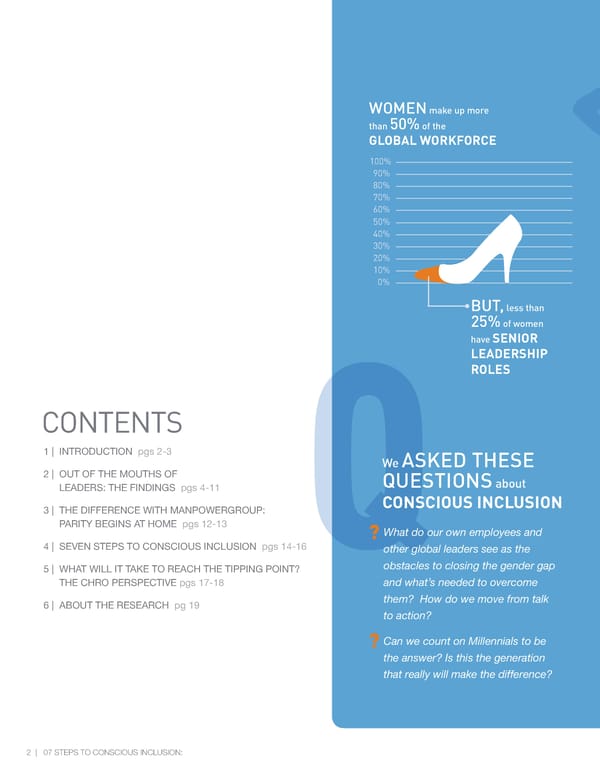
WOMEN make up more than 50% of the GLOBAL WORKFORCE 100% 90% 80% 70% 60% 50% 40% 30% 20% 10% 0% BUT, less than 25% of women have SENIOR LEADERSHIP ROLES CONTENTS 1 | INTRODUCTION pgs 2-3 We ASKED THESE 2 | OUT OF THE MOUTHS OF QUESTIONS about LEADERS: THE FINDINGS pgs 4-11 3 | THE DIFFERENCE WITH MANPOWERGROUP: CONSCIOUS INCLUSION PARITY BEGINS AT HOME pgs 12-13 ?What do our own employees and Q 4 | SEVEN STEPS TO CONSCIOUS INCLUSION pgs 14-16 other global leaders see as the 5 | WHAT WILL IT TAKE TO REACH THE TIPPING POINT? obstacles to closing the gender gap THE CHRO PERSPECTIVE pgs 17-18 and what’s needed to overcome 6 | ABOUT THE RESEARCH pg 19 them? How do we move from talk to action? ?Can we count on Millennials to be the answer? Is this the generation that really will make the difference? 2 | 07 STEPS TO CONSCIOUS INCLUSION:
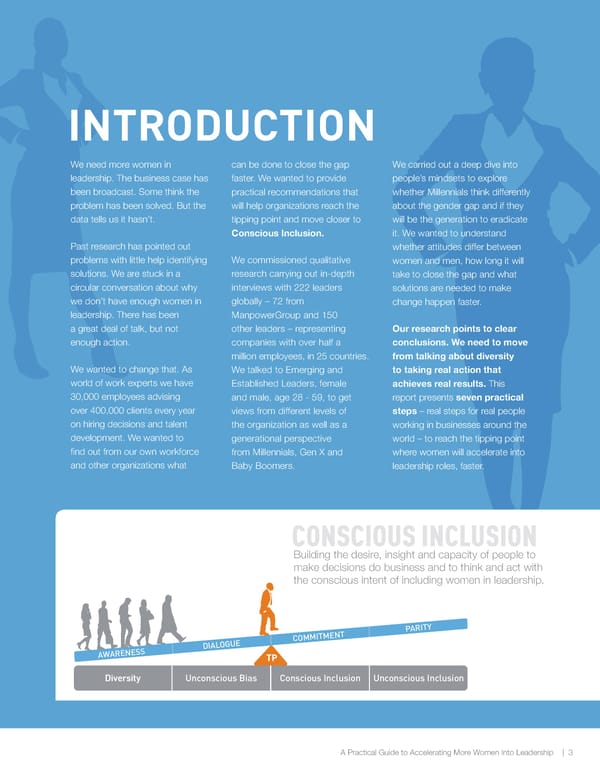
INTRODUCTION We need more women in can be done to close the gap We carried out a deep dive into leadership. The business case has faster. We wanted to provide people’s mindsets to explore been broadcast. Some think the practical recommendations that whether Millennials think differently problem has been solved. But the will help organizations reach the about the gender gap and if they data tells us it hasn’t. tipping point and move closer to will be the generation to eradicate Conscious Inclusion. it. We wanted to understand Past research has pointed out whether attitudes differ between problems with little help identifying We commissioned qualitative women and men, how long it will solutions. We are stuck in a research carrying out in-depth take to close the gap and what circular conversation about why interviews with 222 leaders solutions are needed to make we don’t have enough women in globally – 72 from change happen faster. leadership. There has been ManpowerGroup and 150 a great deal of talk, but not other leaders – representing Our research points to clear enough action. companies with over half a conclusions. We need to move million employees, in 25 countries. from talking about diversity We wanted to change that. As We talked to Emerging and to taking real action that world of work experts we have Established Leaders, female achieves real results. This 30,000 employees advising and male, age 28 - 59, to get report presents seven practical over 400,000 clients every year views from different levels of steps – real steps for real people on hiring decisions and talent the organization as well as a working in businesses around the development. We wanted to generational perspective world – to reach the tipping point find out from our own workforce from Millennials, Gen X and where women will accelerate into and other organizations what Baby Boomers. leadership roles, faster. CONSCIOUS INCLUSION Building the desire, insight and capacity of people to make decisions do business and to think and act with the conscious intent of including women in leadership. ARIT P OMMITMENT OGUE C S DIAL ARENES W A TP Diversity Unconscious Bias Conscious Inclusion Unconscious Inclusion A Practical Guide to Accelerating More Women Into Leadership | 3
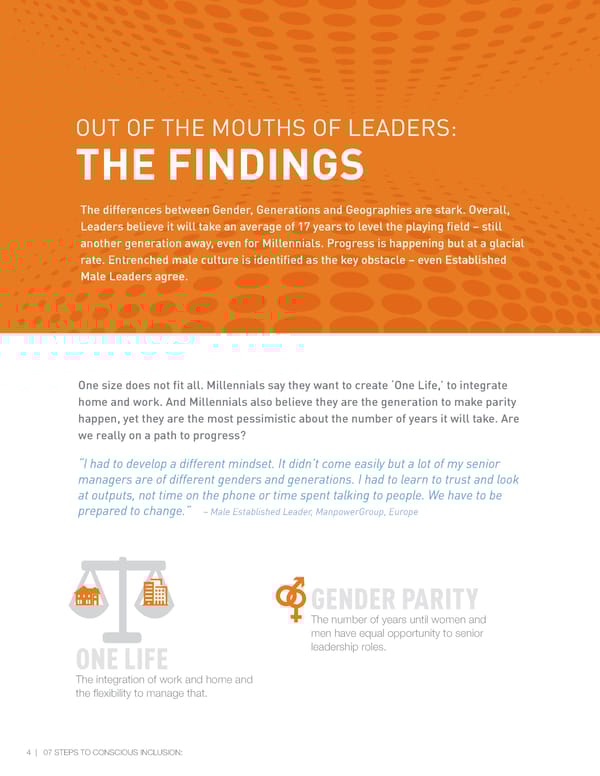
OUT OF THE MOUTHS OF LEADERS: THE FINDINGS The differences between Gender, Generations and Geographies are stark. Overall, Leaders believe it will take an average of 17 years to level the playing field – still another generation away, even for Millennials. Progress is happening but at a glacial rate. Entrenched male culture is identified as the key obstacle – even Established Male Leaders agree. One size does not fit all. Millennials say they want to create ‘One Life,’ to integrate home and work. And Millennials also believe they are the generation to make parity happen, yet they are the most pessimistic about the number of years it will take. Are we really on a path to progress? “I had to develop a different mindset. It didn’t come easily but a lot of my senior managers are of different genders and generations. I had to learn to trust and look at outputs, not time on the phone or time spent talking to people. We have to be ~ Male Established Leader, ManpowerGroup, Europe prepared to change.” GENDER PARITY The number of years until women and men have equal opportunity to senior ONE LIFE leadership roles. The integration of work and home and the flexibility to manage that. 4 | 07 STEPS TO CONSCIOUS INCLUSION:
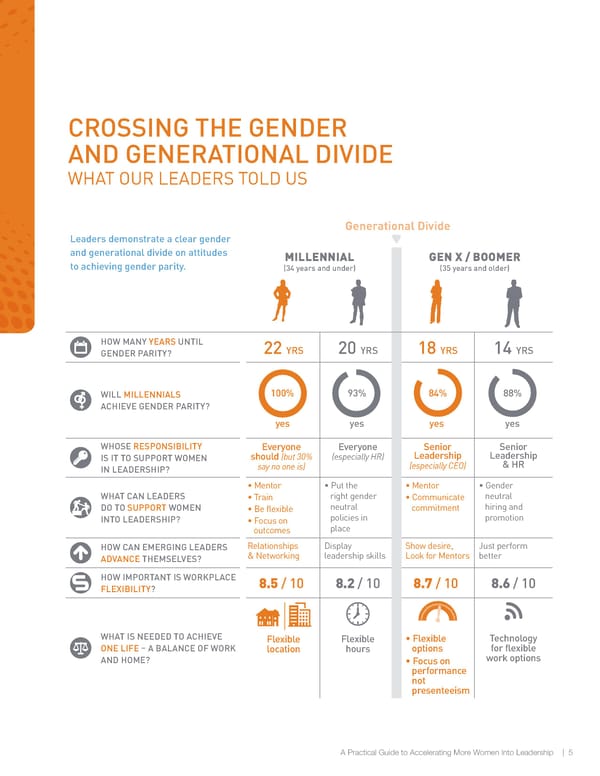
CROSSING THE GENDER AND GENERATIONAL DIVIDE WHAT OUR LEADERS TOLD US Generational Divide Leaders demonstrate a clear gender and generational divide on attitudes MILLENNIAL GEN X / BOOMER to achieving gender parity. (34 years and under) (35 years and older) HOW MANY YEARS UNTIL 22 YRS 20 YRS 18 YRS 14 YRS GENDER PARITY? WILL MILLENNIALS 100% 93% 84% 88% ACHIEVE GENDER PARITY? yes yes yes yes WHOSE RESPONSIBILITY Everyone Everyone Senior Senior IS IT TO SUPPORT WOMEN should (but 30% (especially HR) Leadership Leadership IN LEADERSHIP? say no one is) (especially CEO) & HR • Mentor • Put the • Mentor • Gender WHAT CAN LEADERS • Train right gender • Communicate neutral DO TO SUPPORT WOMEN • Be flexible neutral commitment hiring and INTO LEADERSHIP? • Focus on policies in promotion outcomes place HOW CAN EMERGING LEADERS Relationships Display Show desire, Just perform ADVANCE THEMSELVES? & Networking leadership skills Look for Mentors better HOW IMPORTANT IS WORKPLACE 8.5 / 10 8.2 / 10 8.7 / 10 8.6 / 10 FLEXIBILITY? WHAT IS NEEDED TO ACHIEVE Flexible Flexible • Flexible Technology ONE LIFE – A BALANCE OF WORK location hours options for flexible AND HOME? • Focus on work options performance not presenteeism A Practical Guide to Accelerating More Women Into Leadership | 5
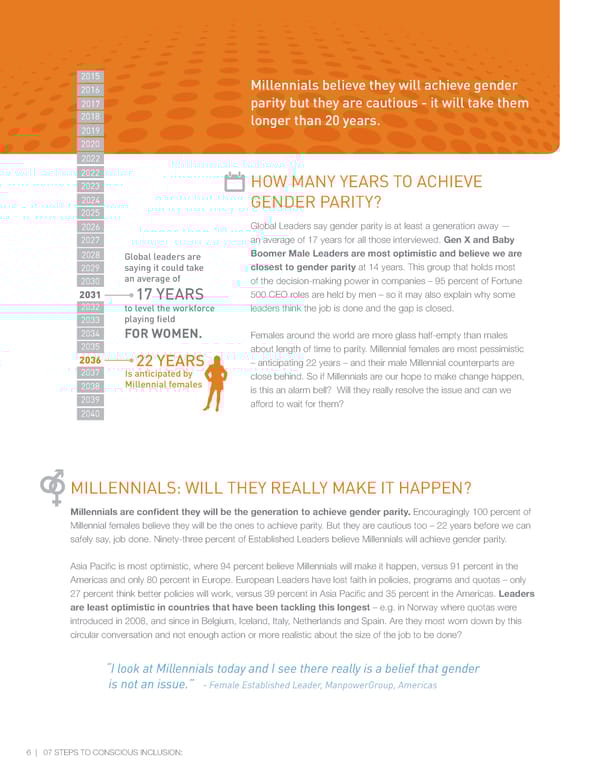
2015 Millennials believe they will achieve gender 2016 2017 parity but they are cautious - it will take them 2018 longer than 20 years. 2019 2020 2027 2022 2022 HOW MANY YEARS TO ACHIEVE 2023 2024 GENDER PARITY? 2025 2026 Global Leaders say gender parity is at least a generation away — 2027 an average of 17 years for all those interviewed. Gen X and Baby 2027 2028 Global leaders are Boomer Male Leaders are most optimistic and believe we are 2029 saying it could take closest to gender parity at 14 years. This group that holds most 2030 an average of of the decision-making power in companies – 95 percent of Fortune 2031 17 YEARS 500 CEO roles are held by men – so it may also explain why some 2032 to level the workforce leaders think the job is done and the gap is closed. 2033 playing field 2034 FOR WOMEN. Females around the world are more glass half-empty than males 2035 about length of time to parity. Millennial females are most pessimistic 2036 22 YEARS – anticipating 22 years – and their male Millennial counterparts are 2037 Is anticipated by close behind. So if Millennials are our hope to make change happen, 2038 Millennial females is this an alarm bell? Will they really resolve the issue and can we 2039 afford to wait for them? 2040 MILLENNIALS: WILL THEY REALLY MAKE IT HAPPEN? Millennials are confident they will be the generation to achieve gender parity. Encouragingly 100 percent of Millennial females believe they will be the ones to achieve parity. But they are cautious too – 22 years before we can safely say, job done. Ninety-three percent of Established Leaders believe Millennials will achieve gender parity. Asia Pacific is most optimistic, where 94 percent believe Millennials will make it happen, versus 91 percent in the Americas and only 80 percent in Europe. European Leaders have lost faith in policies, programs and quotas – only 27 percent think better policies will work, versus 39 percent in Asia Pacific and 35 percent in the Americas. Leaders are least optimistic in countries that have been tackling this longest – e.g. in Norway where quotas were introduced in 2008, and since in Belgium, Iceland, Italy, Netherlands and Spain. Are they most worn down by this circular conversation and not enough action or more realistic about the size of the job to be done? “I look at Millennials today and I see there really is a belief that gender is not an issue.” - Female Established Leader, ManpowerGroup, Americas 6 | 07 STEPS TO CONSCIOUS INCLUSION:
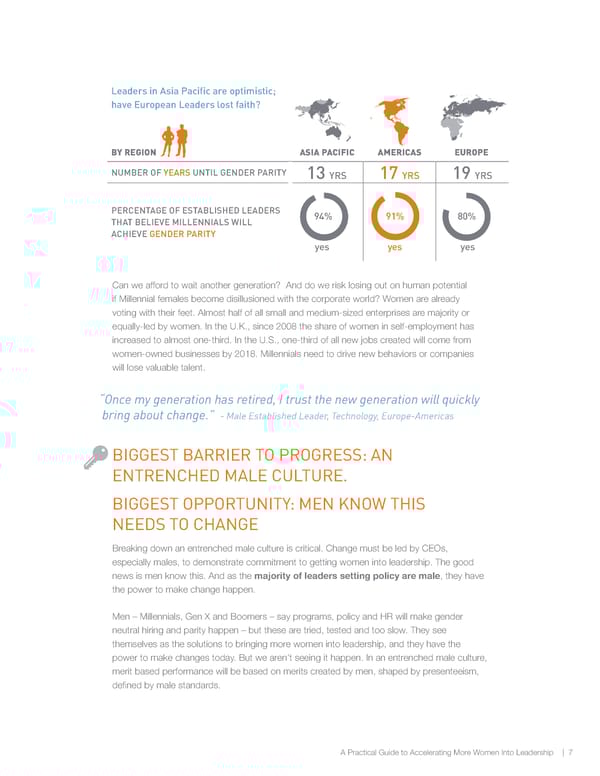
Leaders in Asia Pacific are optimistic; have European Leaders lost faith? BY REGION ASIA PACIFIC AMERICAS EUROPE NUMBER OF YEARS UNTIL GENDER PARITY 13 YRS 17 YRS 19 YRS PERCENTAGE OF ESTABLISHED LEADERS 94% 91% 80% THAT BELIEVE MILLENNIALS WILL ACHIEVE GENDER PARITY yes yes yes Can we afford to wait another generation? And do we risk losing out on human potential if Millennial females become disillusioned with the corporate world? Women are already voting with their feet. Almost half of all small and medium-sized enterprises are majority or equally-led by women. In the U.K., since 2008 the share of women in self-employment has increased to almost one-third. In the U.S., one-third of all new jobs created will come from women-owned businesses by 2018. Millennials need to drive new behaviors or companies will lose valuable talent. “Once my generation has retired, I trust the new generation will quickly - Male Established Leader, Technology, Europe-Americas bring about change.” BIGGEST BARRIER TO PROGRESS: AN ENTRENCHED MALE CULTURE. BIGGEST OPPORTUNITY: MEN KNOW THIS NEEDS TO CHANGE Breaking down an entrenched male culture is critical. Change must be led by CEOs, especially males, to demonstrate commitment to getting women into leadership. The good news is men know this. And as the majority of leaders setting policy are male, they have the power to make change happen. Men – Millennials, Gen X and Boomers – say programs, policy and HR will make gender neutral hiring and parity happen – but these are tried, tested and too slow. They see themselves as the solutions to bringing more women into leadership, and they have the power to make changes today. But we aren’t seeing it happen. In an entrenched male culture, merit based performance will be based on merits created by men, shaped by presenteeism, defined by male standards. A Practical Guide to Accelerating More Women Into Leadership | 7
Overcoming unconscious bias, stereotyping and an entrenched male “Advancing women leadership culture is not easy for women on the way up, nor once they have a to leadership roles seat at the table. Established Female Leaders acknowledge familiar obstacles demands a plan throughout their career – lack of role models, gendered career paths into involving men and support functions like HR and Communications, and a lack of access to women. We don’t sponsors and an influential network. They also talk of having to behave like a man to get to the top, yet once there are unsure of the behaviors expected. need just verbal commitments, there Male Established Leaders are aware of this double bind. They emphasize the have to be measurable need to do things differently though don’t know how to make change happen. changes as well.” But One Size Fits One – what works best for different types of people varies - Male Established Leader, greatly. Shifting the needle requires a wholesale rethinking of culture, Technology, Americas policy, opportunities and the workplace. We cannot change people easily but we can rethink the way we lead, design systems and measure performance so people live and thrive within our organizations. PROMOTING WOMEN LEADERS – WHOSE ROLE IS IT ANYWAY? Wishful thinking, patience and a laissez-faire approach have proven change will not happen. Culture creates change, not policy. Over half of Leaders believe the single most powerful thing an organization can do to promote more women leaders is to create a gender neutral culture. And 58 percent say that responsibility for action lies with the organization, not with the individuals themselves. “The CEO and managers must take the initiative and make it happen. There is no specific department responsible for it.” - Female Established Leader, Construction, Asia Pacific No one is WALKING 59% THE TALK Create a GENDER or MAKING THE NEUTRAL CULTURE COMMITMENT... Over half of Leaders One-third of Millennial believe the single most females said no one powerful thing an in their organization organization can do to is supporting women promote more women into leadership. leaders is to create a gender neutral culture. “It will not change by itself; one has to proactively work towards achieving parity.” - Male Emerging Leader, Travel and Tourism, Asia Pacific 8 | 07 STEPS TO CONSCIOUS INCLUSION:
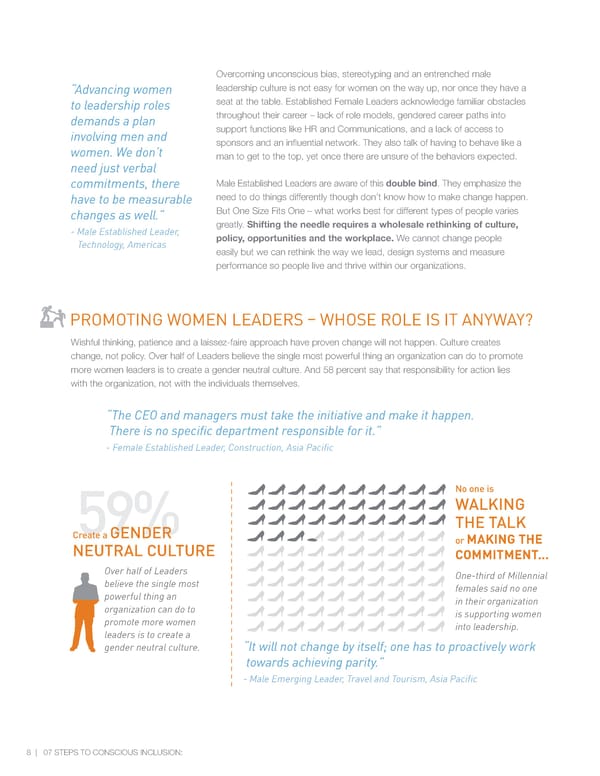
Twelve percent of Established Leaders said that all Emerging Leaders need to be patient and wait to be recognized. This laissez-faire approach is more likely to reward those in the room who shout loudest about their achievements. Regardless of gender, diversity will suffer. Worryingly, one-third of Millennial females said no one in their organization is supporting women into leadership – no one is walking the talk or making the commitment. And concerningly, 32 percent of Male Leaders say the responsibility is HR’s, not theirs. Misplaced accountability means change will not happen. CEOs and senior leaders will change culture by how they walk, talk and deliver on this commitment. “C-suite executives must demonstrate their willingness by giving more opportunities and roles for women. They should build an environment where women are included in all levels and departments. It is more about acting rather than speaking.” - Female Emerging Leader, Telecoms, Asia Pacific WHAT CAN LEADERS DO TO SUPPORT WOMEN INTO LEADERSHIP? Our research is clear: women are not looking for favors, just a level playing field. When asked about what supports women in leadership, Millennial women said flexibility – not a tilted “Mentors help women survive. playing field, but more focus on outcomes that allow them Sponsors help women thrive.” greater control over how and when they get work done. - Mara Swan, ManpowerGroup EVP, Millennial males also say leaders need to collaborate with female Global Strategy and Talent & Global colleagues and champion Emerging Female Leaders. The best Brand Lead for Right Management male leaders are taking women to one side and asking them what they need to succeed, demonstrating their commitment. Now that is good news. In Asia Pacific, Leaders say focus on encouraging and training MENTORS women to take advantage of opportunities that will stretch • Act as a sounding board and develop leadership strengths. They stress the need for • Offer advice and guidance companies to adopt a culture of shared power, driven from • May be inside or outside the top. the organization Gen X and Boomer females most value workplace flexibility and are most frustrated by past challenges of measuring performance SPONSORS VS through presenteeism versus outcomes, or as one U.S. Leader • Offer individual guidance put it, “butts in chairs.” They want leaders walking the talk and • Offer critical feedback taking responsibility for creating a culture of Conscious Inclusion. • Inside the company They also want mentors and training but while mentors may • Most importantly, stick their make women feel more comfortable or act as a sounding neck out and publicly support board, they do not help them move ahead. Sponsorship the individual however consciously advocates for women in the boardroom. This is a critical distinction for leaders to act upon. A Practical Guide to Accelerating More Women Into Leadership | 9
WHAT DO LEADERS NEED TO DO THEMSELVES TO ADVANCE? Genders and generations have very different views on how to advance at work. Gen X and Boomer males – who make up the majority of leaders, remember – say performance is the primary route to career advancement together with cutting edge assignments. But travel, long hours and time away from home tend to accompany these assignments. It’s clear: unless leaders are changing how work gets done and how performance is measured in male cultures, progress will not be made by women. Other Leaders take a broader view. Millennial females say to advance they need to build relationships and network. However women’s networks tend to be female and made up of peers, where they aren’t getting the exposure they need to advance. Gen X and Boomer females agree but are more formal – they say it’s key to have mentors. All women are looking for support – and we need to provide it to retain them – but that won’t guarantee success. Mentoring does not lead to promotion. We may be giving women what they want but that alone will not drive results. We should be cautious and proactive – we know sponsorship is proven to be more effective than mentoring. “There have to be programs to enhance the competencies of women who have the desire and ambition to excel in - Male Established Leader, Technology, Asia Pacific their careers.” In contrast, all male Leaders are more overt and say the best way to advance is to display leadership skills and self-promote, be open to risks, challenges and stretch opportunities. But if women aren’t self-promoting to male leaders who are the majority – how will female leaders advance? And are these leaders guiding women down the route to leadership roles with operations and profit and loss responsibilities, versus the typical support functions? THOUGHTS on WORK Travel, long hours and time away from home tend to accompany cutting edge assignments. ADVANCEMENT It’s clear: unless leaders are changing how work gets done and how performance is measured in male cultures, progress will not be made by women. MILLENNIAL FEMALES GEN X AND BOOMER FEMALES MALE LEADERS Say they need relationships Agree with Millennial Say the best way to advance and networking, but females that they need is to display leadership women’s networks tend to relationships and skills and self-promote, be be female and made of peers, networking, but they are open to risks, challenges where they aren’t getting more formal and say it is and stretch opportunities. the exposure they need. key to have mentors. 10 | 07 STEPS TO CONSCIOUS INCLUSION:
OF LEADERS OF LEADERS 33% MALE 42% ESTABLISHED BELIEVE FLEXIBLE WORKING IS SAY THAT BETTER POLICIES LEADERS KEY TO GETTING MORE WOMEN WOULD REDUCE GENDER BIAS have INTO LEADERSHIP This One Size They believe One Life is more than to get the CULTURE Fits One approach requires a a Millennial aspiration. Female RIGHT culture that values performance Leaders realize the benefit of and output over presenteeism. blending work and home too. “Millennials are much more determined and on board with the idea of having more women in leadership roles. The culture across organizations is changing and having a gender neutral culture lies top of the priority list.” - Female Emerging Leader, Manufacturing, Americas MILLENNIALS WANT ONE LIFE – THE RIGHT BLEND OF WORK AND HOME AT THE RIGHT TIME FOR THEM Forty-two percent of Leaders believe flexible working is key to getting more women into leadership. This One Size Fits One approach requires a culture that values performance and output over presenteeism. Thirty-three percent say that better policies – zero tolerance for gender discrimination, periodic reviews of gender balance and fair practices towards working mothers – would reduce gender bias. And One Life is more than a Millennial aspiration – Established Female Leaders realize the benefit of blending work and home too. So Male Established Leaders have a lot to consider to get the culture right to work for all in the long term. Millennials – female and male – are optimistic that workplaces will be flexible in the future. They expect them to accommodate One Life - the integration of work and home, rather than a balancing act. They see technological advances and the decoupling of work and location as beneficial to both business and family. With a longer working life and later retirement ahead, Emerging Leaders especially emphasized the need to plan and manage career ‘waves’ not ladders. Millennials are preparing to run a work ultramarathon, wanting the flexibility to switch gears at different stages and insisting on One Life that allows them to pursue goals professionally and personally, when it suits them. Millennials are aligned on their goal and intent on changing the way work gets done. They are confident they will be the generation that shifts mindsets, changes culture and achieves parity. IN CONCLUSION: “It’s a question of work-life integration. Figure out for you as an individual what that work-life integration needs to be so that you can do what you need to do both, professionally and personally. Our personal devices have become work devices, and frankly, you can do more things in a better way. You can decide to come in at nine, leave early, no problem. And then do two hours at night, after the kids have gone to bed. Work from home. Brilliant!” - Jonas Prising, CEO ManpowerGroup A Practical Guide to Accelerating More Women Into Leadership | 11
THE DIFFERENCE WITH MANPOWERGROUP: PARITY BEGINS AT HOME At ManpowerGroup we are on our own journey towards unconscious inclusion. We have made good progress in getting women into leadership, creating the culture and commitment that will accelerate this. What has made the difference is that over the last decade our two CEOs have owned it. In 1999, Jeff Joerres, then CEO, made a personal commitment to get women onto an all-male board. Within a decade, over a third of the board was female and remains so today. Jonas Prising, our current CEO, has created his own talent legacy around female leadership. Today, a third of our top executives and half of our Emerging Leaders are female. “Something huge is happening, but it’s interesting why it is happening. It is because our CEO put an emphasis on hiring female leaders, otherwise it would never have happened.” ~ Female Emerging Leader, ManpowerGroup, Europe Today, at ManpowerGroup ...and ONE-HALF of our ONE-THIRD of our TOP EXECUTIVES EMERGING LEADERS are FEMALE... are FEMALE 12 | 07 STEPS TO CONSCIOUS INCLUSION:
MANPOWERGROUP’S PATH TO PARITY 1999 2001 2007 2008 2010 2011 2013 2014 2015 ManpowerGroup Rozanne L. Gina Boswell PINK Libby Sartain Patricia “Cracking Jonas Prising’s Emerging is run by a Ridgeway and Cari magazine joins the Board Hemingway the Case” Legacy Leaders Board and joins the Dominguez names InterOrganization Hall joins is published Experience executive Board join the Board Manpower names Jeff and the Board team of men (since then one of its “Top one of 11 “Guys Jeff Joerres retired) Companies Who Get It” takes the helm for Women” OF MANPOWERGROUP LEADERS BELIEVE THE CEO IS PRIMARILY ACCOUNTABLE 43% FOR GETTING MORE WOMEN INTO LEADERSHIP ROLES IN THE BUSINESS – almost double the figure among non-ManpowerGroup interviewees. “Women-to-women mentorship and male-to-female mentorship is incredibly valuable. Because then you don’t make it a male/female issue, - Male Established Leader, ManpowerGroup, Americas you make it a talent issue.” At ManpowerGroup, top leadership is expected to own this talent legacy – by what they say, what they do and how they lead. So succession planning requires a more deliberate and more purposeful approach to creating a culture that includes women. HR’s role is to support this vision. ManpowerGroup is making good progress, but there is still a way to go. Our CEO reinforces the concept of Conscious Inclusion and his leadership team believes and delivers on it. It is this leadership that has moved ManpowerGroup from a circular conversation about why there aren’t more women in leadership and what we should do about it towards a culture of Conscious Inclusion. Gender parity – here we come. “The messaging has to be clear – we’re an equal opportunity organization, male or female, regardless of age, gender, race. To me that’s really, really important. It has to come from the top and has to be prevalent throughout the organization; otherwise it’s just lip-service.” ~ Male Established Leader, ManpowerGroup, Asia Pacific A Practical Guide to Accelerating More Women Into Leadership | 13
STEPS TO 07 CONSCIOUS INCLUSION Building on what Leaders told us and on our own commitment and experience, we have identified seven practical steps. These Seven Steps will accelerate organizations from circular conversations around awareness and unconscious bias to the tipping point that will help them achieve Conscious Inclusion and eventually parity. BE ACCOUNTABLE; SET MEASURABLE 07 AND ACHIEVABLE OUTCOMES 06 BE EXPLICIT; WOMEN WHEN AND WHERE? PROMOTE A CULTURE OF CONSCIOUS 05 INCLUSION; PROGRAMS ALONE DON’T WORK 04 HIRE PEOPLE WHO VALUE PEOPLE 03 FLIP THE QUESTION – ASK, “WHY NOT?” ? LEADERSHIP HAS TO OWN IT; 02 DON’T DELEGATE IT 01 CHANGE YOURSELF FIRST 14 | 07 STEPS TO CONSCIOUS INCLUSION:
Believe it or don’t bother. Change must be authentic. If not, people 01 see it as a fad that’s here today, gone tomorrow. CHANGE “All of you will be leaders in this company if you want it. YOURSELF The opportunity for you to lead is wide open.” FIRST -Jonas Prising speaking to 16 Female Emerging Leaders, April 2015 “Ultimately the CEO has LEADERSHIP to believe it and endorse it has to own it; because that person then has to 02 DON’T DELEGATE IT inspire a change from the top.” -Female Emerging Leader, ManpowerGroup, Americas The CEO needs to own the issue. Gender parity cannot be delegated to HR. For commitment to be authentic and aligned with business strategy, change must flow from the top and be demonstrated by the leadership team. HR can help facilitate and support it. ? ? 03Flip the QUESTION – ASK, “WHY NOT?” ? ? ? Succession planning must “We need to ask, ‘do we have ? be bolder. Instead of saying, enough women in the succession ? “she doesn’t have the plan?’ If the answer is no, why experience,” ask, “what do not? What can we do to develop ? we need to make it work?” women to make sure they’re in Challenge assumptions. If we the succession path? That’s a ? think it is possible, we can very specific action.” make it possible. -Established Female Leader, ManpowerGroup, Americas If we hire people who value people they will figure out how to optimize all human potential, 04 including women. They will be open to strategies that support One Life – balancing the integration HIRE PEOPLE of work and home, measuring success on performance and quality of output, not who VALUE presenteeism. They will support people to plan PEOPLE and manage for career ‘waves’ not ladders. A Practical Guide to Accelerating More Women Into Leadership | 15
Promote a CULTURE of “Create a culture that promotes CONSCIOUS consciously thinking about inclusion 05 INCLUSION; as if it was a business objective.” programs alone -Male Emerging Leader, don’t work ManpowerGroup, Americas Generic programs do not work. The last three decades prove this. Programs don’t change behaviors and don’t improve the numbers. They can even breed complacency, rewarding activity not the results. Accountability sits with senior leadership and decision makers to promote a culture of Conscious Inclusion. HR can help leaders facilitate change; training can raise awareness. Leaders must change the culture. Simply increasing female representation will not shift the needle. Women and men must be represented at all levels and in every business unit. Leaders must know exactly where they need women to be. Looking at macro numbers 06 is not enough; it results in pink ghettos – women only in HR, Communications and BE EXPLICIT: support roles instead of P&L and staff roles. WOMEN WHEN Women need to be coached and sponsored to succeed, and they need experience and AND WHERE? exposure to advance. Be ACCOUNTABLE: SET MEASURABLE and 07ACHIEVABLE OUTCOMES In business, it is about outcomes and what you want to achieve. Every hiring and promotion decision can be justified but if that isn’t moving closer towards the tipping point then Conscious Inclusion and gender parity just won’t happen. Articulate a talent legacy - how things will change and what it will look like by when. Plan for it as if it were a strategic business priority or investment. True change takes time, focus and discipline. “There need to be clear goals and expectations, a structured process of validating and a formal feedback process.” -Male Emerging Leader, ManpowerGroup, Americas 16 | 07 STEPS TO CONSCIOUS INCLUSION:
WHAT WILL IT TAKE TO REACH THE TIPPING POINT? THE CHRO PERSPECTIVE These global findings point to the critical tipping point: top leadership commitment. Change starts with the CEO – their commitment to action, the talent legacy they want to leave and how they plan to achieve it. It’s proven that the problem will not correct itself. A laissez-faire approach to gender parity has not worked. We cannot keep MARA SWAN, EVP explaining why women are not making it to CEO jobs, or why the top level of management is void of women, or excusing away pay MANPOWERGROUP EVP, GLOBAL inequity. And increasing representation by putting women in STRATEGY AND TALENT & GLOBAL support roles like Communications and HR is just not good BRAND LEAD FOR RIGHT MANAGEMENT enough anymore. That is not shifting the needle. When Leaders cite an entrenched male culture as a major obstacle and yet the majority of leaders are Established Males, we have a big job to do. To me, the end game is simple. Conscious Inclusion is about ensuring all people feel invited in and their human potential is valued. But it’s not easy and there is no quick fix. If organizations are serious about getting more women into leadership roles and including half the talent in the workforce, they must go beyond programs and change the culture. They must put words into action. While the CEO needs to own it to create systemic change, we can all start doing something different today. Change can come BE A CHAMPION from individuals. These are our Seven Steps to Conscious Inclusion. What is the tipping point for your organization? What FOR CHANGE. will you commit to make it happen? Who will you sponsor and ASK, “WHY NOT?” who will you invite in? A Practical Guide to Accelerating More Women Into Leadership | 17
ABOUT THE RESEARCH In August 2015 ManpowerGroup commissioned thought leadership consultancy, Reputation Leaders, to conduct a global study of 222 Established and Emerging Male and Female Leaders, including 72 from ManpowerGroup, to investigate attitudes towards Conscious Inclusion of women in senior leadership roles. Leaders were split between 111 established C-suite executives and 111 next generation leaders aged under 45 reporting into the C-suite or two levels down. There was an equal balance of males and females and regional perspectives from the Americas, Europe and Middle East, and Asia Pacific. Countries included: Australia, Belgium, Bulgaria, Brazil, Canada, China, France, Germany, Greece, India, Israel, Italy, Japan, Malaysia, Mexico, New Zealand, Netherlands, Norway, Poland, Singapore, South Africa, Sweden, U.A.E, U.K., U.S. In-depth interviews took place 7 August - 30 September 2015 totaling more than 130 hours of audio which were transcribed, translated and analyzed using a mixture of qualitative and quantitative methods. 18 | 07 STEPS TO CONSCIOUS INCLUSION:
ABOUT MANPOWERGROUP ® ManpowerGroup (NYSE: MAN) is the world’s workforce expert, creating innovative workforce solutions for more than 65 years. As workforce experts, we connect more than 600,000 people to meaningful work across a wide range of skills and industries every day. Through ® ® ® our ManpowerGroup family of brands – Manpower , Experis , Right Management and ® ManpowerGroup Solutions – we help more than 400,000 clients in 80 countries and territories address their critical talent needs, providing comprehensive solutions to resource, manage and develop talent. In 2015, ManpowerGroup was named one of the World’s Most Ethical Companies for the fifth consecutive year and one of Fortune’s Most Admired Companies, confirming our position as the most trusted and admired brand in the industry. See how ManpowerGroup makes powering the world of work humanly possible: www.manpowergroup.com ABOUT REPUTATION LEADERS Reputation Leaders is a global thought leadership consultancy delivering compelling research that causes people to think about your brand differently. We help companies with brand positioning and create credible thought leadership using global primary and secondary research. A Practical Guide to Accelerating More Women Into Leadership | 19