.jpeg)
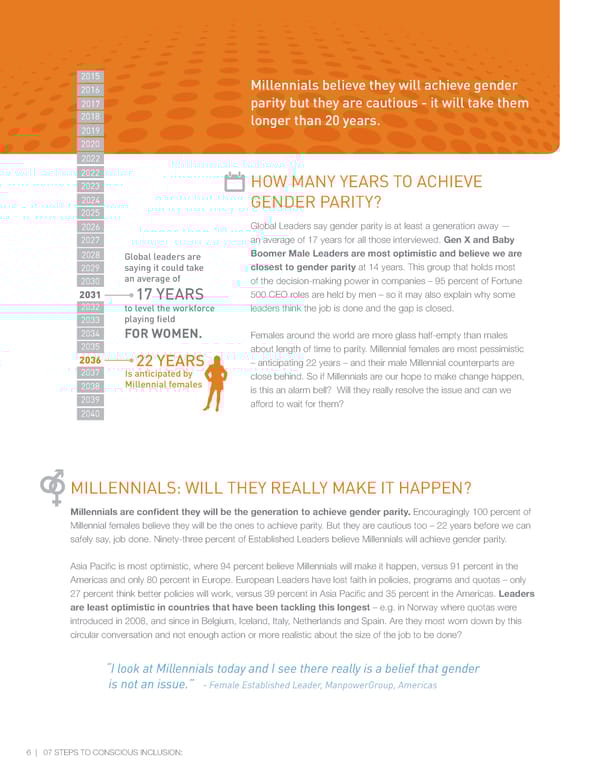
2015 Millennials believe they will achieve gender 2016 2017 parity but they are cautious - it will take them 2018 longer than 20 years. 2019 2020 2027 2022 2022 HOW MANY YEARS TO ACHIEVE 2023 2024 GENDER PARITY? 2025 2026 Global Leaders say gender parity is at least a generation away — 2027 an average of 17 years for all those interviewed. Gen X and Baby 2027 2028 Global leaders are Boomer Male Leaders are most optimistic and believe we are 2029 saying it could take closest to gender parity at 14 years. This group that holds most 2030 an average of of the decision-making power in companies – 95 percent of Fortune 2031 17 YEARS 500 CEO roles are held by men – so it may also explain why some 2032 to level the workforce leaders think the job is done and the gap is closed. 2033 playing field 2034 FOR WOMEN. Females around the world are more glass half-empty than males 2035 about length of time to parity. Millennial females are most pessimistic 2036 22 YEARS – anticipating 22 years – and their male Millennial counterparts are 2037 Is anticipated by close behind. So if Millennials are our hope to make change happen, 2038 Millennial females is this an alarm bell? Will they really resolve the issue and can we 2039 afford to wait for them? 2040 MILLENNIALS: WILL THEY REALLY MAKE IT HAPPEN? Millennials are confident they will be the generation to achieve gender parity. Encouragingly 100 percent of Millennial females believe they will be the ones to achieve parity. But they are cautious too – 22 years before we can safely say, job done. Ninety-three percent of Established Leaders believe Millennials will achieve gender parity. Asia Pacific is most optimistic, where 94 percent believe Millennials will make it happen, versus 91 percent in the Americas and only 80 percent in Europe. European Leaders have lost faith in policies, programs and quotas – only 27 percent think better policies will work, versus 39 percent in Asia Pacific and 35 percent in the Americas. Leaders are least optimistic in countries that have been tackling this longest – e.g. in Norway where quotas were introduced in 2008, and since in Belgium, Iceland, Italy, Netherlands and Spain. Are they most worn down by this circular conversation and not enough action or more realistic about the size of the job to be done? “I look at Millennials today and I see there really is a belief that gender is not an issue.” - Female Established Leader, ManpowerGroup, Americas 6 | 07 STEPS TO CONSCIOUS INCLUSION:
 7 Steps to Conscious Inclusion Page 7 Page 9